
🐶 The kind, science-backed training approach every pet parent should know!
Positive reinforcement training (often referred to as reward-based training or force-free training) is a kind, science-backed way to teach your dog good behaviors by rewarding them for getting things right. Instead of punishing mistakes, this method focuses on catching your dog doing something you like and rewarding it, so it happens more often.
Whenever your dog does something you want to see again, like sitting calmly, coming when called, or walking nicely on leash, you immediately give them something they enjoy: a tasty treat, praise, a toy, or a game. This creates a positive association with the behavior, making your dog more likely to repeat it in the future.
🔎 The Science Behind It
In behavioral science (Applied Behavior Analysis), positive reinforcement means: the process where a specific behavior is followed by the addition of a desirable stimulus, which in turn increases the likelihood that the behavior will occur again in the future.
In simple terms: your dog does something right → you add something they love → your dog learns, “Doing that gets me good stuff!”
This isn’t about “spoiling” your dog – it’s about teaching them how to succeed in your world using motivation, clarity, and consistency.
🐾 How to Use Positive Reinforcement at Home
Here’s how you can apply it in everyday life:
✅ Step-by-Step
- Choose a behavior you want more of
E.g., sitting when greeting people, coming when called, lying quietly on a mat. - Select a reward
Use something your dog loves! Treats are easiest for most dogs – especially small, soft ones that can be given quickly. - Mark the behavior
The moment your dog does the behavior, say “yes!” or use a clicker. This is called a marker – it tells the dog exactly what earned the reward. - Deliver the reward
Immediately follow your marker with the treat or toy. - Repeat, and gradually build the skill
With repetition, your dog will learn the behavior pays off. This will make it stronger and more reliable in the future!
🧲 Tip: Use Luring to Help Your Dog Learn
You don’t always need to wait for a behavior to happen naturally. You can help your dog succeed by luring them into position:
- Hold a treat between your thumb and first two fingers (like a bird’s beak)
- Present it in front of your dog’s nose.
- Move your hand (with the treat) so as to guide your dog into a sit, down, or other position.
- Repeat 5 times with food in hand, then 5 more times with an empty hand (but still reward them after each successful repetition).
- Once the dog reliably offers the behavior, you can introduce a verbal cue (like “sit”) just before they do it.
🎯 Real-Life Examples
🔍 Looking Beyond the Basics: Everyday Wins Through Positive Reinforcement
Sit, down, and stay are valuable skills, but positive reinforcement shines in everyday routines too. Let’s explore some creative, real-life applications that bring training into the heart of daily life:
✅ Getting More Focus on Walks
Say “yes” and reward your dog every single time they look at you. Before long, they’ll start checking in with you much more often! If you’re walking your dog on leash, this habit can also lead to a reduction in pulling, as your dog re-orients to you more frequently in anticipation of a treat.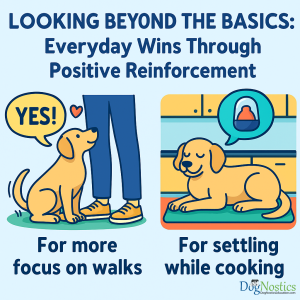
✅ Reward for Relaxing on a Mat While You Cook
Lower a mat to the floor while you prepare food. As soon as your dog approaches it, say “yes” and deliver treats directly onto the mat. If your dog sits -“yes” and treat again. If they lie down – “yes!” and deliver several treats in a row – like it’s ‘raining’ treats! Then give a delicious pre-prepared Kong, Pupsicle, LickiMat, or other interactive feeding toy! Over time, this becomes a default behavior – your dog will happily lie on their mat while you cook!
Tip: Keep interactive feeders ready in the freezer and safe chews stocked, for moments like this.
💡 Why It Works
✅ Builds Trust and Confidence
Your dog learns that good things happen when you’re around, and training becomes a source of fun, not fear.
✅ Promotes Calmness and Focus
Instead of worrying about being punished, your dog is more relaxed, curious, and ready to learn.
✅ Teaches Real-Life Skills
Behaviors like sit, stay, come, settle, and other everyday skills are easily taught through positive reinforcement.
✅ Reduces Unwanted Behavior
When you reinforce behaviors you do want, they naturally replace behaviors you don’t (like jumping, barking, or pulling).
❤️ Bottom Line
Positive reinforcement training is more than just ‘feeding treats’; it’s about setting your dog up for success, rewarding their efforts, and building a relationship based on trust and communication.
It’s one of the most effective, humane, and enjoyable ways to train – and it works for dogs of all ages, breeds, and temperaments!
Want to learn more? Explore our Pet Dog Solutions Courses at DogNostics Education – designed just for pet guardians like you, but also a great resource for trainers!

0 Comments